
Spring peppers are small frogs native to Minnesota. They are included as one of the first signs of spring. Although they are only the size of a dime, males have a loud "Peeper" song that they use to attract mates.
February 28th, 2011


February 20th, 2011
When is Charles Darwin's birthday (month,date, year)February 12th, 2011
A record of the oldest known life on Earth can be found in fossil form. Name these ancient fossilized organisms.
Science Trivia: January 18th, 2011
Is the gene for red hair dominant or recessive? What chromosome is this gene found on?
The gene for red hair is recessive. People with red hair have two copies of the recessive gene found on Chromosome 16. Approximately 1 -2% of the human population has red hair and it is most often associated with people of Northern European descent.
Science Trivia: January 11th, 2011

Science Trivia: January 3rd, 2011

Science Trivia: December 20th, 2010

What arctic plant acts both as a food source for reindeer but also as a way reindeer survive the extreme arctic cold?
Arctic mosses have a low nutritional value and are usually ignored by the larger animals when other food is available. However, these mosses contain high levels of arachidonic acid, which helps cells to keep working at low temperatures. In effect the mosses are supplying the animals with a natural antifreeze compound
Science Trivia: December 13th, 2010
NASA recently discovered bacteria that can use what normally toxic element for food?
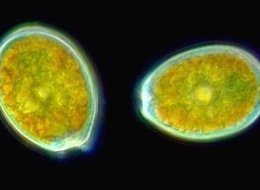
"This organism has dual capability. It can grow with either phosphorous or arsenic. That makes it very peculiar, though it falls short of being some form of truly 'alien' life," commented Paul C. W. Davies of Arizona State University, a co-author of the report appearing in Thursday's online edition of the journal Science."
Science Trivia: December 4th, 2010
In what two countries do both alligators and crocodiles coexist in the same area?
Alligators and crocodiles can be found coexisting in only two places on the Planet. The first is the Everglades in Florida. Here, fresh water alligators (Alligator mississippiensis) share the brackish habitat with salt-water loving crocodiles (Crocodylus acutus). This cohabitation of species can also be found in a small area of China, in the delta's of the Yangtze River. Here, the only other species of alligator on Earth (Alligator sinensis) can be found hanging with the Chinease crocodile species
 Science Trivia: November 28th, 2010
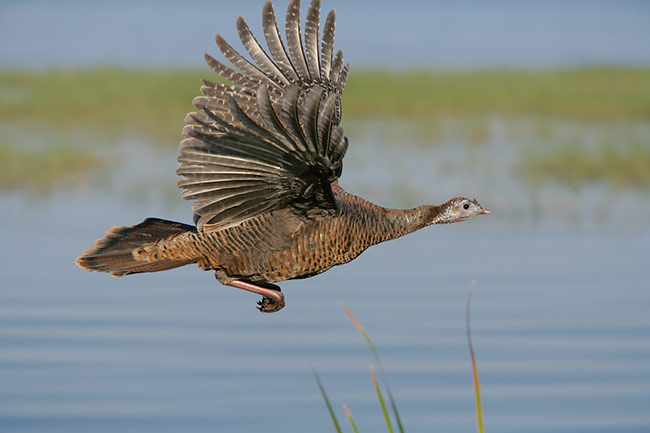
Can wild turkey's fly? If so, how fast can they fly?
Yes! Wild turkeys can fly and have been clocked flying 55 mph! Their domestic cousins, however, have been bred for their breast meat and are too heavy to flyScience Trivia: November 21st 2010
 The smallest beetle in the world is the feather-winged beetle (Nanosella fungi). It has a length of approximately how long?
Nanosella fungi, commonly known as the North American Feather-winged bettle, represents one of the smallest known, with a recorded length under 0.30 mm.
Science Trivia : November 7th 2010
 How fast--in miles per hour---do the fastest messages transmitted by the human nervous system travel?
The Nervous System is composed of specialized celled called neurons that relay electrochemical signals to the brain.
This amazing organ can send messages up to 180 miles per hour; faster than the fastest computer!
Science Trivia: October 30th 2010
What percentage of open ocean organisms produce their own light?
Learn more about bio-luminescent animals
Science Trivia: October 30th 2010
What percentage of open ocean organisms produce their own light?
A.Nearly 80 to 90 percent of animals living in the ocean make light.
Most of the ocean’s bio-luminescent organisms live in the twilight or poor light zone. Animals living in this deep zone include jellyfish, squid, shrimp, krill, marine worms and fish.Learn more about bio-luminescent animals
